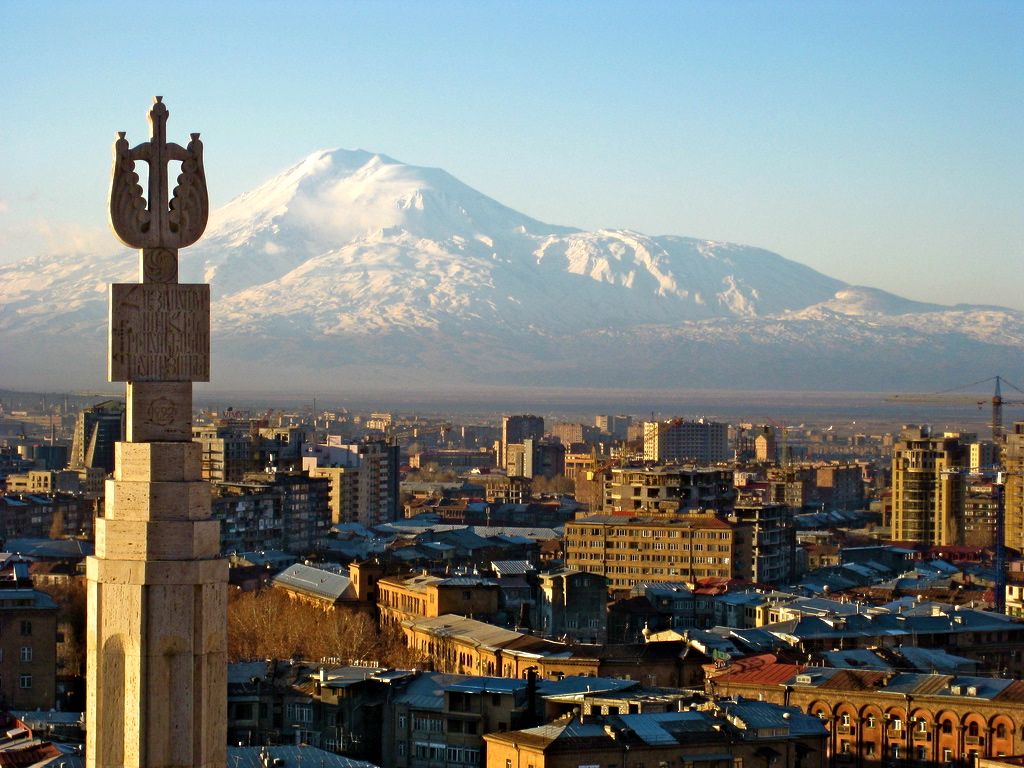
I've waited quite a while to write this post. My reason for this long delay was leavin first impressions behind, and conceiving a more insightful review of my experience in Yerevan, the capital of Armenia.
We've been here for a month and a half now, and we've enjoyed every moment of it. I would love to stay here many more moons but, as life would have it, I have to return home at the end of August. Although our stay here is short, only two more weeks until we go back to our own familiar surroundings, our experiences were many, and there are many still to come.
Since we arrived, we tried to make the most of our short stay, as such we have traveled all throughout the city and outside of it, having a very pleasant time. Of course, there's no such thing as a one sided coin. I'll first begin with the less pleasant experience that travelers will immediately notice if they come here, which concerns traffic. One of our housemates has already expressed his opinion on this matter. As he specified in his post, Armenian traffic is quite chaotic. Traffic laws seem to be but guidelines to the drivers here. Although traffic jams don't occur very often, rush hour is rather slow. The streets are crowded with city cars, buses and an unusually large amount of taxis, that drive down the crowded arteries in a highly disorganized manner. Adding to this, buses, although there are many, they travel rather randomly, suggesting no fixed schedule. This unusual public transportation does also have an upside, which is the fact that once you're outside the city center, you can just wave down the bus, like a taxi, giving one the sensation of hitchhiking by city bus.
This is not the only thing in which Yerevan differs from the European cities that we are used to. This ancient city encompasses many different aspects, blending in the old with the new in a unique way. As a consequence of the 1679 earthquake, much of the city had been turned to rubble. But the most damage done to the ancient architecture was done by human hands. During the communist era, city planning had destroyed much of the old city, in order to build new roads, and wide boulevards. Yerevan is a city in a constant flux of change. Because of this, the city skyline is filled with cranes that are standing near the many new buildings that are still in construction. At street level all this becomes invisible. Although on every second street corner you would find a construction site, with a giant weightlifting monstrosity looming over it, most of the city does not present this unfinished state. Here you are greeted by a typical urban environment with many shops and cafes, people flowing in and out of them. But unlike on the streets of big European cities, here people do not rush through the streets at a high pace, hurrying to their destinations. The local population paces through the streets of Yerevan in a rather relaxed way, generally in groups, rarely would you see people walking alone.
The house we live in is near the outskirts of the city in Kanaker, about an hour from the center. When we first arrived to Yerevan, we didn't really know what kind of housing to expect. The ones of us who have friends that have previously participated in EVS expected apartments. But as our van left the airport's parking lot, we were told that all 12 of us would live together, in one house. We couldn't really imagine where they would want to fit us, or how big the house was going to be. Upon arrival, a large metal gate greeted us, the concrete wall around it overgrown with weeds. Once through the gate, a large 2 storey house, reminding me of Sicilian style villas that crowd the narrow streets of small Italian towns, was looking down at us from a small, cramped courtyard. On our street, houses are almost adjoined. Across the street from our temporary home, the buildings are placed in two rows, and between the ones in the front row, there are narrow, one person corridors, that lead to the ones in the back.
Traveling toward the city center, the landscape changes entirely. The conjoined houses are quickly replaces by apartment building wit shops and cafes at their bases. As you go straight down Azatutyan Avenue, you will eventually reach a large platform at the base of a large WWI monument overlooking the - as of yet - unfinished Cascade Complex. As you head down the stairs in the middle of the platform and then down the road around the construction, you reach the top of the Cascades, an enormous construction, looking down at the Yerevan Opera, and housing the Art Museum under its steps. On top, it houses four outdoor galleries, on its four finished levels, where visitors can take stop, and admire various sculptures, while they catch their breath, getting ready to continue climbing the structure. Below the hundreds of stairs lay a grand square, with even more interesting sculptures displayed through out, and flanked by a large number of themed cafes and restaurants. A small street cuts through it. To the left, it leads to Mashtots Avenue, which leads to the Matenadaran Library of Ancient Scrolls. Ahead of the Cascades, beyond a small park with a terrace cutting through it, you reach Opera Square, in the middle of which stands proud the Yerevan Opera, marking the heart of the city. Still further down, in a straight line, lies North Avenue, a large pedestrian street, having shops and cafes on both flanks, that ends as you reach Abovyan Street, which leads you to Republic Square, home of the National Gallery, host of three museums, and the Singing Fountains of Yerevan, which pamper both the auditive and visual senses of hundreds of visitors, every evening.

Of course there are many other sights worth visiting in this ancient city, as it is filled with street art on almost every corner, and it is home to a very large number of monuments, landmarks, museums and theaters. My description serves but as a motivator to come to this city, and discover the beauty of the capital of this small Caucasian country. If you decide to journey to this city, you will find more then enough attractions that are guaranteed to satisfy your curiosity.

No comments:
Post a Comment